
Core Taxonomy of Artificial Intelligence
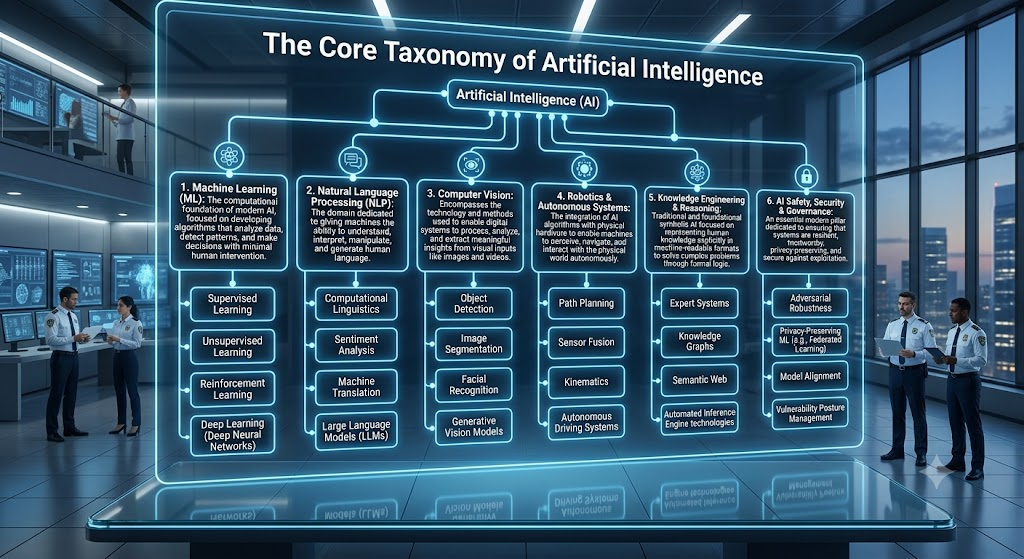
Machine Learning (ML): The computational foundation of modern AI, focused on developing algorithms that analyze data, detect patterns, and make decisions with minimal human intervention.
Sub-branches: Supervised Learning, Unsupervised Learning, Reinforcement Learning, and Deep Learning (Deep Neural Networks).
Natural Language Processing (NLP): The domain dedicated to giving machines the ability to understand, interpret, manipulate, and generate human language.Sub-branches: Computational Linguistics, Sentiment Analysis, Machine Translation, and Large Language Models (LLMs).
Computer Vision: Encompasses the technology and methods used to enable digital systems to process, analyze, and extract meaningful insights from visual inputs like images and videos.Sub-branches: Object Detection, Image Segmentation, Facial Recognition, and Generative Vision Models.
Robotics & Autonomous Systems: The integration of AI algorithms with physical hardware to enable machines to perceive, navigate, and interact with the physical world autonomously.Sub-branches: Path Planning, Sensor Fusion, Kinematics, and Autonomous Driving Systems.
Knowledge Engineering & Reasoning: Traditional and foundational symbolic AI focused on representing human knowledge explicitly in machine-readable formats to solve complex problems through formal logic.Sub-branches: Expert Systems, Knowledge Graphs, Semantic Web, and Automated Inference Engine technologies.
AI Safety, Security & Governance: An essential modern pillar dedicated to ensuring that systems are resilient, trustworthy, privacy-preserving, and secure against exploitation.Sub-branches: Adversarial Robustness, Privacy-Preserving ML (e.g., Federated Learning), Model Alignment, and Vulnerability Posture Management.