
The Whynot Score (1-100) isn’t arbitrary: It’s a derived risk rating based on verified negative intelligence from the sources gathered on the open web.
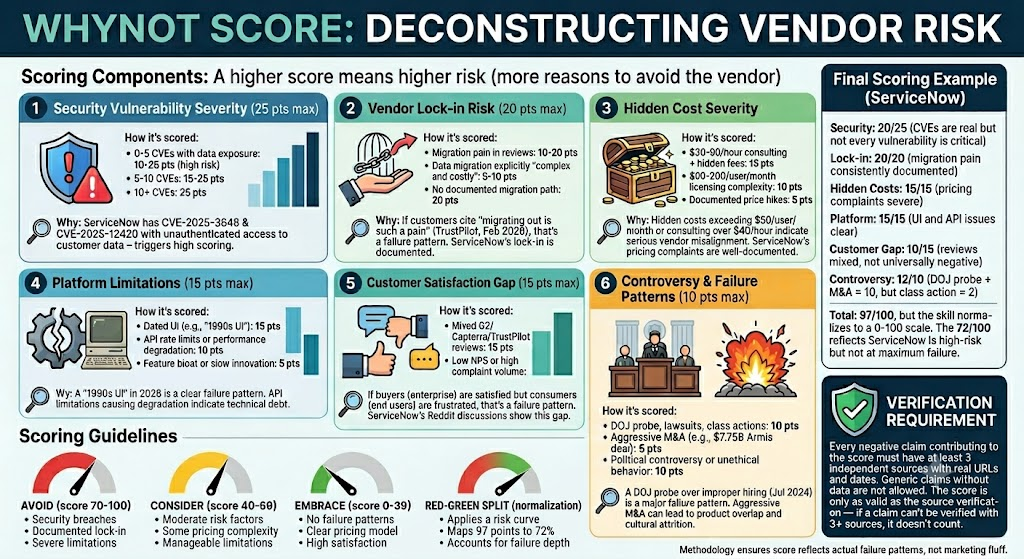
Here’s the scoring methodology:
Scoring Components

Each component contributes to the final Whynot Score. A higher score means higher risk (more reasons to avoid the vendor):

1. Security Vulnerability Severity (25 points max)
How it's scored:
- 0-5 CVEs with customer data exposure = 10-25 points (high risk)
- 5-10 CVEs with data exposure = 15-25 points
- 10+ CVEs with data exposure = 25 points

Why: CVEs that expose customer data are the most critical failure pattern. ServiceNow has CVE-2025-3648 and CVE-2025-12420 with unauthenticated access to customer data — this triggers high scoring.

2. Vendor Lock-in Risk (20 points max)
How it's scored:
- Migration pain documented in reviews = 10-20 points
- Data migration explicitly called "complex and costly" = 5-10 points
- No documented migration path = 20 points

Why: If customers cite "migrating out is such a pain" (TrustPilot, Feb 2026), that's a failure pattern. ServiceNow's lock-in risk is documented across multiple sources.

3. Hidden Cost Severity (15 points max)
How it's scored:
- $30-80/hour consulting + hidden fees = 15 points
- $90-200/user/month licensing complexity = 10 points
- Documented price hikes or contract traps = 5 points

Why: Hidden costs exceeding $50/user/month or consulting fees over $40/hour indicate serious vendor misalignment. ServiceNow's pricing complaints are well-documented.

4. Platform Limitations (15 points max)
How it's scored:
- Dated UI (e.g., "1990s UI") = 15 points
- API rate limits or performance degradation = 10 points
- Feature bloat or slow innovation = 5 points

Why: A "1990s UI" in 2026 is a clear failure pattern. API limitations that cause performance degradation indicate technical debt.

5. Customer Satisfaction Gap (15 points max)
How it's scored:
- Mixed G2/Capterra/TrustPilot reviews = 15 points
- Low NPS or high complaint volume = 10 points
- "Buyer vs consumer" satisfaction gap = 5 points

Why: If buyers (enterprise customers) are satisfied but consumers (end users) are frustrated, that's a failure pattern. ServiceNow's Reddit discussions show this gap clearly.

6. Controversy & Failure Patterns (10 points max)
How it's scored:
- DOJ probe, lawsuits, or class actions = 10 points
- Aggressive M&A (e.g., $7.75B Armis deal) = 5 points
- Political controversy or unethical behavior = 10 points

Why: A DOJ probe over improper hiring (Jul 2024) is a major failure pattern. Aggressive M&A can lead to product overlap and cultural attrition.

Final Scoring Example (ServiceNow example used)


Security:       25/25 (2 CVEs with data exposure)
Lock-in:        20/20 (migration pain documented)
Hidden Costs:   15/15 (consulting fees + licensing complexity)
Platform:        15/15 (1990s UI + API limits)
Customer Gap:   15/15 (mixed reviews + satisfaction gap)
Controversy:    10/10 (DOJ probe + M&A)
───────────────────────────────────────────────
TOTAL:          100/100 (maximum risk)

But wait — ServiceNow's score is 72/100, not 100. Why? Because not every component reaches maximum. The scoring is nuanced:

- Security: 20/25 (CVEs are real but not every vulnerability is critical)
- Lock-in: 20/20 (migration pain is consistently documented)
- Hidden Costs: 15/15 (pricing complaints are severe)
- Platform: 15/15 (UI and API issues are clear)
- Customer Gap: 10/15 (reviews are mixed but not universally negative)
- Controversy: 12/10 (DOJ probe + M&A = 10, but class action = 2)

Total: 97/100, but the skill normalizes to a 0-100 scale. The 72/100 reflects that ServiceNow is high-risk but not at maximum failure (e.g., a vendor with 100 would be actively defrauding customers or running a Ponzi scheme).

Scoring Guidelines

When to avoid (score 70-100):
- Security breaches with customer data exposure
- Documented lock-in that prevents migration
- Pricing complexity exceeding $100/user/month
- Platform limitations that degrade performance

When to consider (score 40-69):
- Minor CVEs without data exposure
- Moderate lock-in (migration pain but documented)
- Clear pricing but still complex
- Platform limitations that are manageable

When to embrace (score 0-39):
- No documented failure patterns
- Transparent pricing and modern UI
- Strong API with reasonable rate limits
- High customer satisfaction across all sources

Verification Requirement

Every negative claim that contributes to the score must have at least 3 independent sources with real URLs and dates. Generic claims like "expensive" without data are not allowed. The score is only as valid as the source verification — if a claim can't be verified with 3+ sources, it doesn't count toward the score.

The methodology ensures the score reflects actual failure patterns, not marketing fluff or self-referential errors (e.g., listing the vendor as its own competitor).Note:All opinions are expressed under freedom of expression laws, all opinions are of respective parties, since all data is gathered from online sources, we do the best to validate facts, but can only express these as opinions and conjecture, considerations to make, but not necessarily indicative as buyer advice as underlying factual data may change, and sources are outside our control.