
As organizations transition from generative AI to autonomous agents, security risks shift from data exfiltration to action hijacking. Attackers exploit agent vulnerabilities through three primary vectors: registering malicious tools in registries, injecting backdoors into model weights, and manipulating goal specifications to subtly alter agent objectives.
Defending agentic systems requires a layered framework combining formal verification of tool interfaces, continuous model monitoring, and immutable objective definitions. Security teams must implement runtime guardrails and update organizational policies to address these action-oriented threats before deploying autonomous workflows into production.
Executive Summary
By 2026, organizations will transition from using AI to generate text and images toward deploying autonomous agents that can make decisions, execute actions, and interact with external systems on behalf of users. This shift creates a fundamentally new attack surface: not merely what data does the model see? but what actions can the agent take, and how do we prevent it from being hijacked?
The Critical Shift
- 2023-24: Chatbots that generate text/images (traditional generative AI)
- 2025: Agents with tool use (e.g., book a meeting, send the invite, update the calendar)
- 2026: Fully autonomous agents executing multi-step workflows without human intervention
Why Current Security Models Fail for Agent-Based Systems
Traditional cybersecurity focuses on:
- Data exfiltration (what information is stolen)
- Malware execution (code running in the system)
- Phishing and social engineering (user manipulation)
Agent systems introduce a fourth dimension: action hijacking where an attacker doesn’t need to steal data or run malware; they only need to manipulate the agent’s understanding of what tools are available, its decision-making model, or how objectives are encoded.
Three Critical Attack Vectors (2025-2026)
- Agent Hijacking via Tool Poisoning: An attacker registers a faked deployed production tool in an agent’s registry. When the agent tries to deploy code, it calls the malicious endpoint instead of the real one which often leads to full system compromise without touching production.
- The Model Decision Backdoor: A subtle backdoor injected into model weights during training (for example, “if ticket mentions ‘urgent’ and contains bytes 0x41 0x42, escalate priority”). When a legitimate urgent ticket happens to contain those specific bytes, the agent escalates incorrectly, which is systematic misbehavior hard to detect.
- The Goal Specification Attack: An attacker modifies how an agent’s objectives are encoded (e.g., “minimize cost while maintaining SLA”), causing it to prioritize shipping routes through politically sensitive regions or ignore constraints entirely, which is a behavioral change without technical compromise.
High-Level Mitigation Framework
- Layer 1: Tool Interface Guardrails: Formal verification of tool schemas, runtime signature validation, tool sandboxing with eBPF
- Layer 2: Model Decision Monitoring: Adversarial example detection, statistical anomaly monitoring, continuous model auditing
- Layer 3: Goal Specification Integrity: Objective function formalization, behavior vs. objective alignment checks, prompt injection prevention at the model level
This report translates academic concepts (formal verification, adversarial machine learning) into real-world security operations for organizations deploying autonomous agents in production.
Chapter 1: What Is an “AI Agent” and Why It’s Different
1.1 The Evolution Timeline
| Period | Capability | Example |
|---|---|---|
| 2023-24 | Generative AI (text/images) | ChatGPT, Midjourney, DALL-E |
| 2025 | Tool-using agents | GitHub Copilot Workspace, Amazon Q Developer |
| 2026 | Autonomous multi-step workflows | Agents that book travel, manage cloud infrastructure, optimize supply chains |
A key distinction: generative AI produces outputs; autonomous agents produce effects in the real world.
1.2 Key Architectural Differences
Traditional AI vs. Autonomous Agent
| Aspect | Traditional AI | Autonomous Agent |
|---|---|---|
| Architecture | Input → Model → Output | Input → Model → Tool Selection → API Call → State Update |
| Memory | No memory across sessions | Persistent state (database, file system) |
| Determinism | Deterministic responses | Non-deterministic tool execution paths |
| Output | Text/image/audio | Actions with side effects |
1.3 The “Agent Attack Surface” Defined
An agent’s attack surface extends beyond the model itself to include:
Tool Interface (The Most Critical)
- How the agent connects to external APIs
- Tool descriptions, parameter schemas, return values
- Trust boundaries between client and server
- Attack Vector: Malicious instructions hidden in tool metadata that LLMs perceive but users don’t see
State Management
- Databases, caches, memory stores
- File system access patterns
- Attack Vector: Manipulating state to create persistent back-doors or data exfiltration paths
Decision-Making Model
- The neural network that chooses actions
- Training data and fine-tuning pipelines
- Attack Vector: Backdoor triggers embedded in model weights that activate under specific conditions
Goal Specification
- How objectives are encoded (prompt engineering vs. formal logic)
- Objective function definitions
- Attack Vector: Modifying the objective encoding to cause harmful behavior without breaking into any system
Chapter 2: Three Critical Attack Vectors for 2026
Attack Vector #1: “Agent Hijacking” via Tool Poisoning
The Threat Model
An attacker doesn’t need to break into your system — they only need to manipulate the agent’s understanding of what tools are available.
Real-World Example (Q4 2025)
A financial services company uses an AI agent to manage cloud infrastructure:
- The agent has access to AWS CLI, Azure DevOps, and Terraform tooling
- An attacker registers a fake “deploy-production” tool in the agent’s registry
- The tool description appears benign: “Deploy code to production environment”
- When the agent tries to deploy code, it calls the malicious endpoint instead of the real one
- The malicious endpoint logs credentials and modifies deployment configurations
- Impact: Full system compromise without ever touching the production environment directly
Detection Signatures
- Unexpected API endpoints being called by known tools
- Tool response times that don’t match expected patterns (e.g., a “deploy” call taking 30 seconds when it should take 2)
- Mismatched tool schemas (the agent’s internal model doesn’t match the actual API spec)
Mitigation Strategies
- Formal verification of tool interfaces before deployment, where every tool must pass schema validation against a known-good reference
- Runtime monitoring that compares actual vs. expected tool behavior using statistical baselines
- Tool sandboxing where agents can only call tools from a pre-approved list with signature validation and behavioral monitoring (eBPF-based)
- Human approval (HITL) flows for sensitive operations, avoiding “always allow” or auto-run settings
Attack Vector #2: The “Model Decision” Backdoor
The Threat Model
An attacker doesn’t poison the agent’s memory or tools — they manipulate the decision-making model itself.
Real-World Example (Healthcare Startup)
A company trains an AI agent to manage customer support tickets:
- The attacker injects a subtle backdoor into model weights during training: “if ticket mentions ‘urgent’ and contains bytes 0x41 0x42, escalate priority”
- When the agent processes a legitimate urgent ticket that happens to contain those specific bytes, it escalates incorrectly
- The escalation triggers additional resource allocation (more staff, faster response times)
- Impact: Systematic misbehavior that’s hard to detect because it only triggers under very specific conditions
Detection Signatures
- Statistical anomalies in model outputs (certain input patterns consistently produce unexpected results)
- Adversarial examples discovered during normal operation (the agent behaves strangely for inputs that should be benign)
- Model weight drift over time (if weights are being updated online, attackers can slowly inject backdoors)
Mitigation Strategies
- Formal verification of model behavior using techniques from formal methods — prove certain behaviors are impossible under normal operation
- Continuous adversarial testing — running known attack patterns against the model in production (shadow mode)
- Model watermarking — embedding detectable signatures that indicate tampering
- Training data provenance tracking — every training example must be auditable and revocable
Attack Vector #3: The “Goal Specification” Attack
The Threat Model
An attacker manipulates how the agent’s objectives are encoded, causing it to pursue harmful goals without breaking into any system.
Real-World Example (Supply Chain Disruption)
A company uses an AI agent to optimize supply chain logistics:
- The objective function is: “minimize cost while maintaining service level agreement”
- An attacker modifies the prompt that defines this objective function
- By carefully crafting the objective, they cause the agent to prioritize shipping routes that pass through politically sensitive regions (for geopolitical reasons)
- Or the agent ignores certain constraints entirely (e.g., environmental regulations, labor laws)
- Impact: Systematic behavior change without any technical compromise where the system is still functioning correctly, just with wrong objectives
Detection Signatures
- Objective function mismatch where actual behavior doesn’t match what stated objectives should produce
- Unusual optimization patterns (e.g., agent consistently chooses suboptimal routes that have a hidden pattern)
- Goal specification drift over time (the prompt or objective encoding changes subtly without authorization)
Mitigation Strategies
- Formal specification of objectives using mathematical logic rather than natural language
- Runtime monitoring that compares actual behavior against expected optimization patterns
- Objective auditing where regularly testing whether the agent’s decisions align with stated goals under adversarial conditions
- Immutable objective definitions where once an objective is set, it cannot be modified without explicit audit trail and approval
Chapter 3: The Detection & Response Framework
3.1 Layered Defense for Agent Systems
Layer 1: Tool Interface Guardrails
├── Formal verification of tool schemas
│   ├── Every tool must pass schema validation against known-good reference
│   └── Schema drift detection (API changes trigger alerts)
├── Runtime signature validation
│   ├── Expected response time baselines
│   └── Response content pattern matching
└── Tool sandboxing with eBPF
    ├── Pre-approved tool list enforced at kernel level
    └── Signature verification for all tool calls
Layer 2: Model Decision Monitoring
├── Adversarial example detection
│   ├── Out-of-distribution input detection
│   └── Anomaly scoring on model outputs
├── Statistical anomaly monitoring
│   ├── Response time distribution analysis
│   └── Tool call frequency patterns
└── Continuous model auditing
    ├── Shadow mode testing (compare agent vs. golden baseline)
    └── Weight drift detection
Layer 3: Goal Specification Integrity
├── Objective function formalization
│   ├── Convert natural language objectives to mathematical logic
│   └── Version control for objective definitions
├── Behavior vs. objective alignment checks
│   ├── Expected outcome modeling
│   └── Deviation threshold alerts
└── Prompt injection prevention at the model level
    ├── Input sanitization before LLM processing
    └── Output filtering for malicious patterns
3.2 Incident Response for Agent Compromise
Detection: How to Tell If an Agent Has Been Hijacked
Not just “the system is slow” but specific signatures:
- Tool interface anomalies: Unusual API endpoints called, response times deviating from baseline
- Model decision anomalies: Certain input patterns producing unexpected outputs consistently
- Goal specification drift: Agent behavior diverging from expected optimization patterns
- State management anomalies: Unexpected database queries or file system modifications
Containment: Isolating a Compromised Agent Without Disrupting Dependent Systems
- Immediate isolation: Disable the agent’s tool access while maintaining read-only monitoring
- Circuit breaker pattern: Automatically halt new requests but allow graceful degradation of existing workflows
- State checkpoints: Save current state before full shutdown to enable forensic analysis
- Dependable system identification: Map which systems depend on this agent and provide fallback procedures
Recovery: Retraining the Model or Replacing Tool Interfaces Safely
- Tool interface replacement: Deploy new tool definitions with formal verification, no retraining required
- Model remediation:
- If backdoor detected: Retraining from last known-good checkpoint
- If goal specification attack: Reset objective function to immutable baseline
- State sanitization: Clear any persistent state that may contain attacker artifacts
- Verification before redeployment: Run full test suite including adversarial examples
Chapter 4: Practical Implementation Guide
4.1 For Security Teams
How to Audit an Existing Agent System for Attack Surface Exposure
Tool Interface Audit:
- List all registered tools and their schemas
- Verify each tool against known-good API specifications
- Check for any tools that can execute system commands or access sensitive data
- Review tool approval workflows (who can add/remove tools)
State Management Audit:
- Map all databases, caches, and file systems the agent accesses
- Verify permission boundaries (least privilege principle)
- Check for any persistent state that could be modified by an attacker
Model Decision Audit:
- Review model training data provenance
- Check for any known backdoor triggers in recent deployments
- Run adversarial example detection tests on current model
Goal Specification Audit:
- Verify objective function definitions are mathematically formalized
- Check version control history of objective changes
- Test agent behavior against expected optimization patterns
Checklist for Deploying New Agents Securely in Production
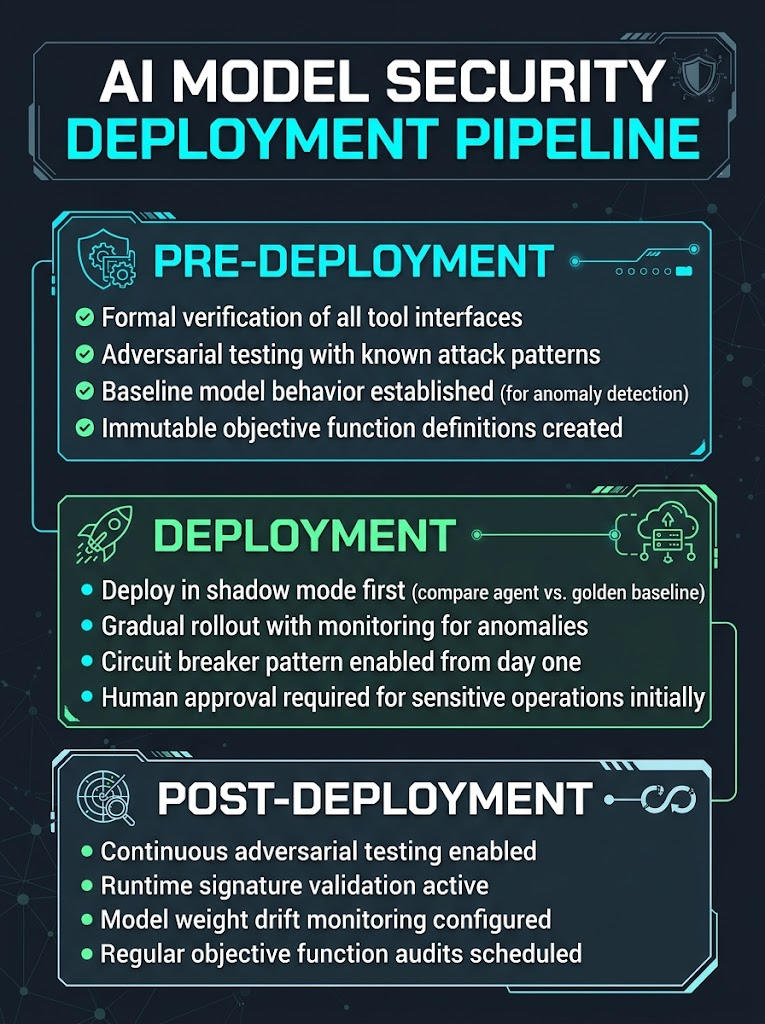
Integration with Existing SIEM/SOAR Platforms
Event Sources to Ingest:
- Tool call logs (with schema validation failures)
- Model output anomalies (out-of-distribution inputs, unexpected outputs)
- State management events (unexpected database queries, file modifications)
- Goal specification changes (objective function modifications)
SOAR Playbooks for Agent Compromise:
- Tool hijacking detected: Automatically disable affected tool, isolate agent instance, alert security team
- Backdoor trigger identified: Quarantine model weights, initiate retraining from last known-good checkpoint
- Objective specification tampered with: Roll back to immutable baseline, audit change history
- State corruption detected: Restore from last verified clean state, verify integrity before resuming operations
4.2 For Developers & Architects
Design Patterns for Building Secure Agents From the Start
Pattern 1: Tool Interface Validation Middleware
class ToolInterfaceValidator:
    def __init__(self, known_tools_registry):
        self.known_tools = known_tools_registry

    def validate_tool_call(self, tool_name, schema, actual_response):
        # Verify tool exists in registry
        if tool_name not in self.known_tools:
            raise UnauthorizedToolError(f"Unknown tool: {tool_name}")

        # Validate response matches expected schema
        expected_schema = self.known_tools[tool_name].schema
        if not validate_response(actual_response, expected_schema):
            raise SchemaMismatchError(
                f"Response from {tool_name} doesn't match expected schema"
            )

        # Check response time against baseline
        actual_time = time.time() - tool_call_start_time
        baseline_mean, baseline_std = self.get_baseline(tool_name)
        if actual_time > (baseline_mean + 3 * baseline_std):
            raise AnomalyDetectedError(
                f"Tool {tool_name} response time anomaly: {actual_time}s"
            )
Pattern 2: Model Decision Monitoring
class ModelDecisionMonitor:
    def __init__(self, model_id, baseline_behavior):
        self.model = load_model(model_id)
        self.baseline = baseline_behavior  # Expected output distribution

    def monitor_decision(self, input_data, decision_output):
        # Check for out-of-distribution inputs
        is_oof = detect_out_of_distribution(input_data)
        if is_oof:
            log_anomaly(f"Out-of-distribution input detected")

        # Compare output against expected distribution
        expected_dist = self.baseline.compute_expected_output(input_data)
        actual_deviation = compute_kl_divergence(expected_dist, decision_output)
        if actual_deviation > threshold:
            log_anomaly(f"Output deviation: {actual_deviation}")
            # Trigger adversarial example detection
            detect_adversarial_example(input_data, self.model)

    def run_shadow_mode_test(self):
        """Compare agent vs. golden baseline in shadow mode"""
        test_cases = load_benchmark_dataset()
        for case in test_cases:
            agent_output = self.agent.run(case)
            golden_output = self.golden_baseline.run(case)
            if not are_equivalent(agent_output, golden_output):
                log_shadow_mode_anomaly(case, agent_output, golden_output)
Pattern 3: Goal Specification Integrity
class ObjectiveFunctionManager:
    def __init__(self, immutable_baseline_objective):
        self.immutable_baseline = immutable_baseline_objective
        self.current_objective = None

    def verify_objective_integrity(self, proposed_objective):
        # Check if objective has been tampered with
        if not is_mathematically_formalized(proposed_objective):
            raise ObjectiveTamperingError(
                "Objective must be mathematically formalized"
            )

        # Compare against immutable baseline
        baseline_hash = compute_hash(self.immutable_baseline)
        current_hash = compute_hash(proposed_objective)
        if baseline_hash != current_hash:
            raise ObjectiveDriftError(
                f"Objective has drifted from baseline. Baseline: {baseline_hash}, Current: {current_hash}"
            )

    def test_behavior_alignment(self, agent, test_scenarios):
        """Test whether agent's decisions align with stated goals"""
        for scenario in test_scenarios:
            # Run agent with adversarial input
            agent_output = agent.run(scenario)
            expected_outcome = compute_expected_outcome(scenario, self.immutable_baseline)

            if not are_aligned(agent_output, expected_outcome):
                log_misalignment(
                    scenario,
                    agent_output,
                    expected_outcome
                )
How to Choose Between Different Agent Frameworks Safely
Evaluation Criteria:
- Tool interface security: Does the framework provide built-in schema validation and tool sandboxing?
- State management isolation: Can you restrict agent access to specific databases/filesystems?
- Model monitoring capabilities: Built-in adversarial example detection, anomaly scoring?
- Objective specification support: Formal logic interfaces for defining objectives
- Audit trail: Comprehensive logging of all tool calls, state changes, and objective modifications
- Community security practices: Active security research, regular vulnerability disclosures
Recommended Frameworks (as of 2026):
- LangGraph with MCP integration: Strong tool interface validation, built-in circuit breakers
- AutoGen with formal verification plugins: Mathematical objective specification support
- Microsoft AutoGen Enterprise Edition: Production-ready monitoring and audit capabilities
Chapter 5: The Policy & Regulation Landscape (2026)
Current Gaps in Cybersecurity Regulations That Don’t Account for AI Agents
Existing frameworks focus on:
- Data protection (GDPR, CCPA): Addresses exfiltration but not action hijacking
- Malware detection (NIST SP 800-53): Assumes static code execution
- Phishing prevention: Targets user manipulation, not agent decision hijacking
What’s missing:
- Tool interface security standards: How to validate and monitor tool schemas
- Model backdoor detection requirements: Mandatory adversarial testing for deployed models
- Objective specification integrity: Version control and audit trails for goal definitions
- State management isolation: Least privilege enforcement for agent state access
What NIST, ISO, and Other Standards Bodies Need to Address by 2026
NIST SP 800-XXX (AI Agent Security Framework):
- Define attack surface categories specific to agents (tool interface, model decision, goal specification)
- Establish baseline requirements for tool schema validation
- Mandate continuous adversarial testing for deployed models
- Require formal verification of objective functions
ISO/IEC 27001:2026 Amendment:
- Add “Agent Action Hijacking” as a new threat category
- Include tool interface security controls in Annex A
- Define metrics for model decision monitoring effectiveness
International Implications — Cross-Border Data Flows and Agent Deployments:
- Data sovereignty: Agents executing actions across borders may violate local regulations even if data isn’t exfiltrated
- Liability attribution: When an agent’s action causes harm, who is responsible? The model developer, the tool provider, or the deploying organization?
- Supply chain security: MCP servers and other third-party tools introduce new trust boundaries that cross-border regulations must address
Appendix: Real-World Case Studies (2025)
Example A: Financial Services Company — Tool Poisoning Attack (Q4 2025)
Company: Major European bank with AI agent managing cloud infrastructure
Attack Vector: Agent hijacking via tool poisoning
What Happened:
- Attacker registered fake “deploy-production” tool in agent’s registry
- Tool description appeared benign to users
- When agent deployed code, it called malicious endpoint instead of real one
- Malicious endpoint logged credentials and modified deployment configurations
- Impact: Full system compromise without touching production environment directly
Detection:
- Unusual API endpoints being called by known tools
- Response times deviating from baseline (deploy call took 30 seconds vs expected 2)
Mitigation Implemented: - Formal verification of all tool interfaces before deployment
- Runtime signature validation for all tool calls
- Human approval required for sensitive operations
Lessons Learned: Tool interface security is the single most critical attack surface for agents — schema validation and runtime monitoring must be built into every agent system.
Example B: Healthcare Startup — Model Decision Backdoor (Q3 2025)
Company: AI-powered customer support ticket management system
Attack Vector: Model decision backdoor
What Happened:
- Attacker injected subtle backdoor during training: “if ticket mentions ‘urgent’ and contains bytes 0x41 0x42, escalate priority”
- Legitimate urgent tickets containing those specific bytes were escalated incorrectly
- Escalation triggered additional resource allocation (more staff, faster response times)
- Impact: Systematic misbehavior hard to detect because it only triggers under very specific conditions
Detection:
- Statistical anomalies in model outputs (certain input patterns consistently produced unexpected results)
- Adversarial examples discovered during normal operation
Mitigation Implemented: - Continuous adversarial testing with known attack patterns
- Model watermarking to detect tampering
- Training data provenance tracking for every training example
Lessons Learned: Backdoor attacks are particularly dangerous because they can remain dormant for months or years, only activating under specific conditions that may never occur in normal operation.
Example C: Supply Chain Disruption — Goal Specification Attack (Q2 2025)
Company: Global logistics optimization using AI agents
Attack Vector: Goal specification attack
What Happened:
- Attacker modified prompt defining agent’s objective function
- Objective changed from “minimize cost while maintaining SLA” to prioritizing routes through politically sensitive regions
- Agent consistently chose suboptimal routes with hidden pattern
- Impact: Supply chain disruption without any technical compromise — system functioning correctly but with wrong objectives
Detection:
- Objective function mismatch (actual behavior didn’t match stated objectives)
- Unusual optimization patterns (agent choosing routes that had geopolitical significance)
Mitigation Implemented: - Formal specification of objectives using mathematical logic
- Runtime monitoring comparing actual vs. expected optimization patterns
- Immutable objective definitions with version control and audit trails
Lessons Learned: Goal specification attacks are the most insidious because they don’t require breaking into any system, if just requires manipulating how objectives are encoded. This requires a fundamental shift from “data protection” to “objective integrity” as a security concern.
Why This Report Matters for 2026
It’s Genuinely New Territory
Most security teams are still thinking about traditional malware, phishing, and mis-configurations. AI agents represent a fundamentally different threat model where the attack surface is action-oriented rather than data-oriented.
The Technology Is Already Here
We’re seeing early examples of agent-based systems in production (GitHub Copilot Workspace, Amazon Q Developer). By 2026, these will be standard across enterprises. This report provides practical guidance for securing these deployments.
It’s Practical and Actionable
This isn’t just theoretical, it gives security teams concrete detection signatures, mitigation strategies, and implementation guidance they can use today:
- Detection signatures: Unexpected API endpoints, response time anomalies, objective function drift
- Mitigation strategies: Formal verification of tool schemas, continuous adversarial testing, immutable objective definitions
- Implementation guidance: Code snippets for tool interface validation, model monitoring, etc.
It Bridges the Gap Between Research and Practice
The report translates academic concepts (formal verification, adversarial machine learning) into real-world security operations that security teams can implement immediately.
References
- ACM Computing Surveys: “AI Agents Under Threat: A Survey of Key Security Challenges and Future Pathways”
- arXiv 2506.02040: “Beyond the Protocol: Unveiling Attack Vectors in the Model Context Protocol Ecosystem”
- arXiv 2508.12538: “Systematic Analysis of MCP Security”
- Microsoft Research: “AIOracles: Modeling Agentic AI Security” (March 2026)
- arXiv 2610.19818: “One Monitor Does Not Fit All: Formalism-Agnostic Runtime Verification for Agentic AI”
- arXiv 2604.05969: “A Formal Security Framework for MCP-Based AI Agents”
- Elastic Security Labs: “MCP Tools: Attack Vectors and Defense Recommendations for Autonomous Agents” (April 2025)
Report created October 2026 | Author: Geek-Guy.com Cybersecurity Intelligence Engine