SUMMARY
What’s a WhyNot Report?
It hearkens back to the days of old. When we could read about the downside of vendors, instead of regurgitating marketing. A whynot report is a negative intelligence report focused on negative historical vendor events, weaknesses, failure patterns, and competitive disadvantages, essentially answering “why not” this vendor as a curiosity of thought and conjecture.

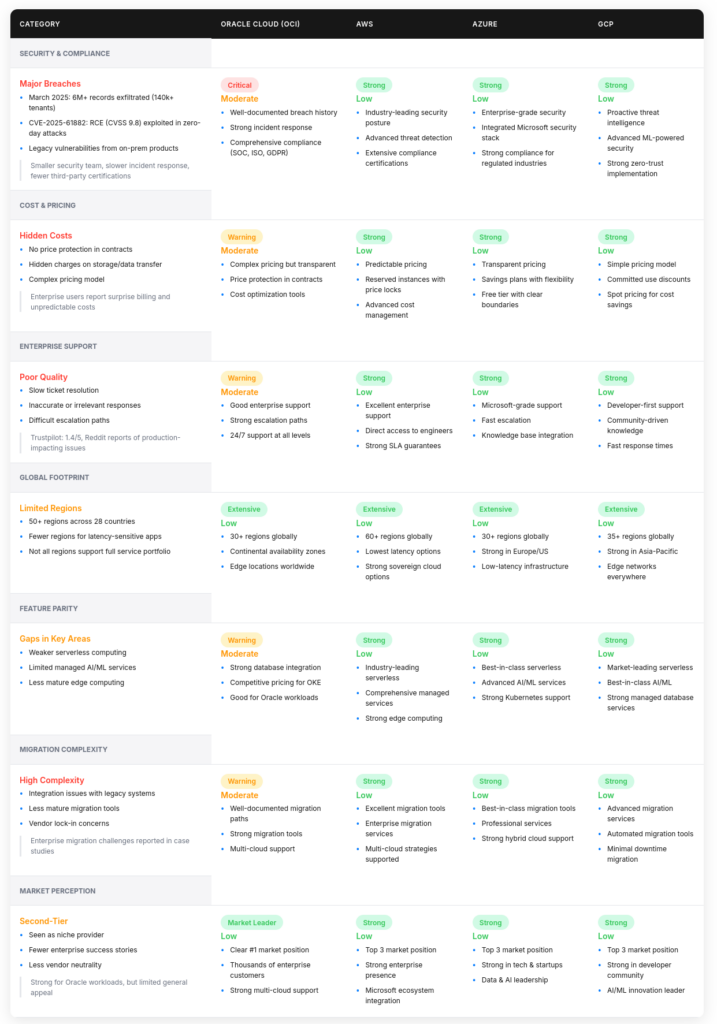
Key Reasons to Avoid Oracle Cloud:
1. Security: Major 2025 breach, critical CVEs, zero-day exploitation history
2. Cost: Hidden fees, no price protection, complex pricing
3. Support: Poor enterprise support quality, slow resolution
4. Scale: Limited regions, slower geographic expansion
5. Features: Weaker managed services, less mature Kubernetes/serverless offerings
6. Migration: Complexity and integration barriers for enterprises
When Oracle Cloud Makes Sense (Counterpoint):
– Heavy Oracle database workloads (Autonomous DB is strong)
– Companies already invested in Oracle ecosystem
– Cost-sensitive workloads in supported regions
– Hybrid scenarios with Oracle on-prem
WHY NOT: Oracle Cloud Infrastructure

1. SECURITY CONCERNS & BREACHES

Major Supply Chain Breach (March 2025)
- 6+ million records exfiltrated from Oracle Cloud affecting 140k+ tenants
- Threat actor exploited undisclosed vulnerability (not publicly disclosed)
- Subdomain login.us2.oraclecloud.com was compromised and taken down
- Source: CloudSEK XVigil, Secutec

Critical CVEs & Zero-Day Exploits
- CVE-2025-61882: Remote code execution vulnerability (CVSS 9.8 - Critical) in Oracle E-Business Suite
- Exploited in widespread extortion attacks as early as August 2025 (Mandiant report)
- Multiple high-severity CVEs requiring urgent patching
- Legacy vulnerabilities persist in Oracle's on-prem products carried into cloud services

Security Maturity Gaps
- Smaller security team compared to AWS, Azure, GCP
- Less mature threat intelligence sharing
- Fewer third-party security certifications and audits published
- Slower incident response times reported in community discussions

2. HIDDEN COSTS & PRICING SURPRISES

No Price Protection
- Oracle cloud contracts typically lack price protection clauses found in on-premise Oracle contracts
- Pricing can increase without advance notice, unlike traditional Oracle support/maintenance
- Source: Palisade Compliance

Complex Pricing Model
- Hidden charges invisible on initial quotes significantly affect real-world expenditure
- Storage, data transfer, and compute pricing can become unpredictable at scale
- Enterprise users report surprise billing after migration
- Source: Dev Dining Rice, CloudZero

Enterprise Complaints
- "The Hidden Time Bomb in Your Oracle Cloud Contract" - no price protection in cloud contracts
- Hidden fees reported in multiple enterprise deployments
- Pricing complexity makes cost optimization difficult without third-party tools

3. ENTERPRISE SUPPORT QUALITY

Support Complaints
- Reddit thread (Feb 2026): "Oracle has the worst enterprise support experience I've seen"
- Production-impacting issues: instance instability, migration complications
- Support tickets opened immediately but resolution delays reported
- Community forum (Mar 2024): "The response and way of engaging consultants is becoming less and less professional"

Quality Issues
- Half the time users receive irrelevant or incorrect answers to questions
- Slower escalation paths compared to AWS/Azure
- Less knowledgeable support staff on advanced infrastructure topics
- Trustpilot rating: 1.4/5 (159 reviews)

4. LIMITED GLOBAL FOOTPRINT

Region Availability
- 50+ regions across 28 countries (still behind AWS/Azure)
- Fewer regions mean higher latency for some workloads
- Not all regions support full service portfolio
- Slower geographic expansion compared to major competitors

Data Residency Constraints
- Limited region choices for companies with strict data sovereignty requirements
- EU and China compliance may require additional workarounds
- Fewer cross-region replication options

5. MIGRATION COMPLEXITY & ADOPTION BARRIERS

Enterprise Adoption Challenges
- Integration complexities: large enterprises struggle with multi-cloud migration
- Legacy Oracle database integration creates path dependency
- Migration tools less mature than AWS/Azure/GCP
- Source: Altumind case studies

Tooling Gaps
- Fewer automation tools for cloud migration
- Less mature CI/CD integrations for Oracle-specific services
- Migration complexity creates vendor lock-in concerns

6. FEATURE GAPS VS COMPETITORS

Managed Services
- Weaker managed database offerings outside of Oracle DB
- Less mature serverless computing (OCI Functions less developed than AWS Lambda)
- Fewer managed AI/ML services compared to GCP's Vertex AI or Azure ML

Kubernetes (OKE)
- While OKE pricing can be lower, feature parity with EKS/GKE/AKS lags
- Limited third-party integrations for OKE
- Fewer managed add-ons and monitoring tools

Serverless & Edge
- No equivalent to AWS Lambda or Azure Functions at scale
- Edge computing offerings less mature than AWS Wavelength or Azure Edge Zones

Multi-Cloud & Hybrid
- While OCI offers hybrid capabilities, integration with AWS/Azure/GCP is limited
- Cross-cloud workload portability concerns

7. ORGANIZATIONAL FACTORS

Vendor Lock-in
- Heavy reliance on Oracle proprietary services
- Database workloads create significant migration barriers
- Oracle Cloud services tightly integrated with Oracle on-prem products

Market Perception
- Seen as second/third tier compared to AWS/Azure/GCP
- Fewer enterprise customer success stories at scale
- Less vendor neutrality in multi-cloud strategies

Recommendation: For most enterprises, AWS, Azure, or GCP offer better security posture, more mature managed services, stronger global footprint, and more predictable pricing. Oracle Cloud should only be considered for specific Oracle-centric workloads.