
Executive Summary
Current IAM protocols face fundamental gaps when dealing with autonomous AI agents that can act, not just access data. The ratio of machine to human identities has reached 82:1, with AI agents representing a new, harder-to-govern class. Traditional standards like SAML/OIDC are being extended (SPIFEE, SPIRE) but require more radical evolution in credential lifecycle, attestation, and real-time threat response.
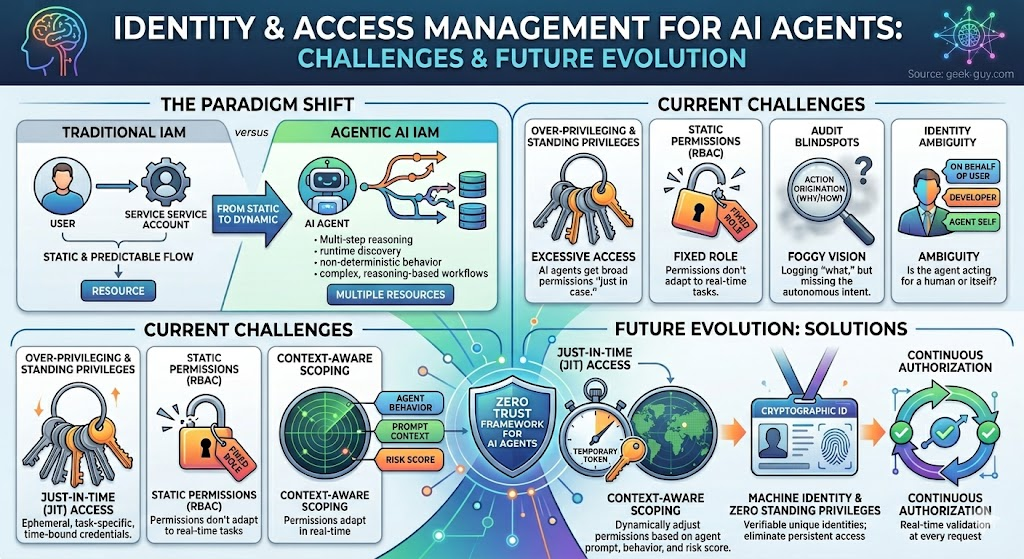
The standards that will matter most in 2026-2028 are SPIFEE and SPIRE for strong attestation, DID/VC for cross-organizational trust, and behavioral authorization for dynamic control. But the biggest challenge is not the protocol since it’s the willingness to abandon the human-centric paradigm that has dominated IAM for 20 years.
Part 1: Critical Challenges in Current IAM Protocols

1. The Non-Human Identity Governance Vacuum

Problem: Enterprise IAM systems were designed for human users, not autonomous systems that can spawn thousands of ephemeral identities.

- 88% of organizations report confirmed/suspected AI agent security incidents (Cloud Security Alliance, 2026)
- Machine identities outnumber humans 82:1 (CyberArk, 2025)
- Excessive permissions are the #1 issue for AI agents; they inherit human credentials or are granted overly broad access
- No real-time revocation for compromised agent identities; traditional IAM token revocation doesn't propagate fast enough for autonomous systems

Why protocols fail:
- SAML/OIDC focus on long-lived sessions and human authentication, not ephemeral workload identities
- OAuth 2.1 lacks fine-grained, attribute-based authorization for dynamic AI agent workloads
- No credential attestation for verifying that an agent's private keys match its claimed identity in real-time

2. Identity Attestation and Verification Gaps

Problem: Agents can claim identities without cryptographic proof of their actual runtime environment or security posture.

- No real-time attestation of agent's private keys to a trusted authority (SPIFEE addresses this, but adoption is lagging)
- Credential lifetime mismanagement — agents often use short-lived tokens that don't support complex multi-step workflows
- Token leakage — agents can exfiltrate credentials as "data" or accidentally include them in logs/prompts

Why protocols fail:
- Traditional PKI lacks verifiable credential semantics for workload identity
- No continuous authorization — tokens are valid regardless of current threat posture
- Static credential lifecycles don't support adaptive trust based on real-time risk signals

3. The "Who Governs the Machine?" Problem

Problem: Autonomous agents can make decisions, not just execute commands. Current IAM only controls access, not behavior.

- Privilege escalation happens silently — an agent can escalate its permissions if its initial access token is valid
- Data exfiltration looks like "normal automation" — IAM can't distinguish a legitimate agent from a compromised one
- No behavioral baselines — IAM protocols don't establish expected agent patterns for anomaly detection

Why protocols fail:
- OAuth scopes are too coarse-grained for agent-specific behavioral controls
- No agent-specific policies — IAM systems treat all non-human identities the same
- No behavioral attestation — protocols don't capture what an agent is doing, not just what it can access

4. Cross-Platform and Cross-Boundary Identity Fragmentation

Problem: AI agents operate across cloud, edge, and on-premises systems with no unified identity model.

- Multiple identity providers — each agent needs separate credentials per system
- No federated agent identity — an agent's identity is not portable across domains
- Legacy protocol incompatibility — SPIFEE/SPIRE can't interoperate with existing SAML/OIDC infrastructure

Why protocols fail:
- SPIFEE is still nascent (2025-2026) and lacks mature ecosystem support
- SPIRE focuses on Kubernetes-native identities, not enterprise-wide federation
- OASIS standards (SAML, OIDC, XACML) don't address agent-specific requirements

5. Threat Response and Dynamic Authorization

Problem: IAM protocols assume static credentials and trust boundaries. They can't respond to real-time threats.

- Token revocation takes minutes or hours, not milliseconds
- No dynamic re-authentication for suspicious agent behavior
- No threat intelligence integration — IAM doesn't know about active exploits targeting agent credentials

Why protocols fail:
- JWT token structure lacks dynamic, revocable claims
- No behavioral authorization — protocols don't support "if this agent is acting suspiciously, revoke access"
- No continuous authentication — tokens are valid regardless of current threat signals


Part 2: Emerging Standards and Their Capabilities

SPIFEE (Secure Production Identity Framework for Everyone)

What it does:
- Provides strongly attested, cryptographic identities for workloads across platforms
- Uses Verifiable Identity Documents (SVIDs) — cryptographically signed credentials
- Supports continuous attestation of the runtime environment

Capabilities for AI agents:
- ✅ Strong identity attestation — agents prove their private keys match a trusted authority
- ✅ Short-lived credentials — supports ephemeral agent identities
- ✅ Cross-platform portability — works across cloud, on-prem, edge

Limitations:
- ⚠️ No behavioral authorization — doesn't control what agents do after authentication
- ⚠️ Limited ecosystem maturity — only a few production deployments in 2026
- ⚠️ No real-time threat integration — attestation doesn't factor in dynamic risk signals

SPIRE (SPIFFE Runtime Environment)

What it does:
- Provides the runtime component for SPIFEE
- Automates certificate issuance and renewal for workloads
- Supports multi-cluster and multi-cloud deployments

Capabilities for AI agents:
- ✅ Automated credential lifecycle — no manual certificate management
- ✅ Workload identity — each agent gets a unique, verifiable identity
- ✅ Short-lived credentials — reduces credential exposure window

Limitations:
- ⚠️ Kubernetes-focused — not designed for enterprise-wide federation
- ⚠️ No behavioral controls — same as SPIFEE
- ⚠️ No threat integration — credentials are valid regardless of current risk

OASIS Standards (SAML, OIDC, XACML)

What they do:
- SAML — enterprise single sign-on and federation
- OIDC — open standard for identity, authentication, and authorization
- XACML — attribute-based access control

Capabilities for AI agents:
- ✅ Enterprise maturity — 20+ years of production use
- ✅ Cross-platform support — works with most IAM systems
- ✅ Fine-grained authorization — XACML supports complex policies

Limitations:
- ⚠️ Human-centric design — sessions are designed for human users, not autonomous systems
- ⚠️ No attestation — protocols don't verify runtime environment
- ⚠️ Static credentials — tokens are valid regardless of current threat posture
- ⚠️ No dynamic authorization — policies don't adapt to real-time signals

Decentralized Identifiers (DID) and Verifiable Credentials (VC)

What they do:
- DIDs — self-sovereign digital identities independent of any central authority
- VCs — cryptographically signed credentials that can be verified without trusting a central issuer

Capabilities for AI agents:
- ✅ Self-sovereign identity — agents can prove identity without relying on a central PKI
- ✅ Verifiable credentials — no need for trusted certificate authorities
- ✅ Privacy-preserving — agents can prove specific attributes without revealing full identity

Limitations:
- ⚠️ Emerging standard — no mature production deployments yet
- ⚠️ No behavioral controls — same as SPIFEE/SPIRE
- ⚠️ Blockchain complexity — requires trust in blockchain infrastructure
- ⚠️ No real-time threat integration — credentials are valid regardless of current risk


Part 3: How Protocols Must Evolve for AI Agent Security

1. Behavioral Authorization and Dynamic Policies

Current state: IAM only controls what an agent can access, not what it does.

Required evolution:
- Agent-specific behavioral baselines — establish normal patterns (API calls, data access, timing)
- Real-time policy evaluation — revoke or escalate permissions based on current behavior
- Multi-step authorization — support complex workflows where permissions change based on progress

Example:

If agent makes 10x normal API calls → revoke token + alert security team
If agent accesses data outside normal hours → require re-authentication
If agent succeeds in step 1 of 5-step workflow → grant step 2 permissions


2. Continuous Attestation and Runtime Trust

Current state: Credentials are valid for their entire lifetime, regardless of runtime conditions.

Required evolution:
- Continuous attestation — verify agent's runtime environment every few seconds
- Dynamic trust scoring — factor in threat intelligence, network conditions, and behavioral anomalies
- Automatic credential renewal — short-lived credentials with rolling renewal based on trust signals

Example:

If agent's runtime environment is compromised → revoke credential immediately
If threat intelligence detects exploit targeting agent identity → require re-authentication
If agent's behavior is anomalous → shorten credential lifetime


3. Cross-Domain Federated Agent Identity

Current state: Each system requires separate agent credentials.

Required evolution:
- Federated agent identity — one identity that works across all systems
- Portable credentials — SVIDs/VCs that are universally recognized
- Cross-boundary authorization — policies that work across cloud, on-prem, and edge

Example:

An agent's SPIFFE identity is recognized by every system it needs to access
Credentials are portable across cloud providers and on-premises systems
Authorization policies are federated, not siloed


4. Real-Time Threat Integration

Current state: IAM credentials are valid regardless of current threat signals.

Required evolution:
- Threat intelligence feeds — integrate with exploit databases and threat actor profiles
- Dynamic policy adjustment — change authorization based on active threats
- Automatic credential revocation — revoke credentials when threats are detected

Example:

If threat intelligence detects an exploit targeting agent credentials → automatically revoke all active tokens
If network conditions show signs of lateral movement → require re-authentication for all agents
If behavioral anomaly correlates with known threat actor TTPs → escalate to security team


5. Multi-Tier Authorization and Delegated Permissions

Current state: Tokens grant all or nothing permissions.

Required evolution:
- Multi-tier authorization — permissions that change based on task progress
- Delegated permissions — agents can delegate sub-identities to other agents
- Temporal policies — permissions that expire based on task completion

Example:

Step 1: Grant read-only access to dataset
Step 2: After successful read, grant write access to staging environment
Step 3: After successful analysis, grant deploy access to production
Step 4: All permissions automatically expire after task completion


6. Agent-Specific Lifecycle Management

Current state: Human-centric identity lifecycle (join, leave, change role).

Required evolution:
- Ephemeral identity creation — agents can be created/destroyed in milliseconds
- Automatic credential rotation — credentials rotate based on trust signals, not just time
- Self-service identity management — agents can request and manage their own credentials

Example:

Agent starts task → automatically requests short-lived credential
Credential is valid for 5 minutes → auto-renews if trust remains high
Agent completes task → credential is automatically revoked


Part 4: Implementation Roadmap (2026-2028)

2026: Foundation Layer

- Adopt SPIFEE/SPIRE for new agent deployments
- Establish behavioral baselines for existing agents
- Integrate threat intelligence into IAM systems
- Implement continuous attestation for critical agents

2027: Behavioral Controls

- Deploy dynamic policy engines that factor in real-time signals
- Implement multi-tier authorization for complex agent workflows
- Create cross-domain federated identity for multi-cloud deployments
- Build threat-responsive credential management

2028: Autonomous Identity

- Self-service agent identity — agents can create/rotate their own credentials
- Fully dynamic trust scoring — continuous evaluation of agent behavior and environment
- Blockchain-based verifiable credentials for cross-organizational trust
- AI-powered anomaly detection that automatically revokes suspicious credentials
Conclusions
Current IAM protocols are fundamentally misaligned with the capabilities and risks of autonomous AI agents. The gap is not just technical — it’s philosophical. SAML/OIDC/SPIFEE were designed for humans who authenticate once and then work within static permission boundaries. AI agents are ephemeral, autonomous, and operate across boundaries without human intervention.
The evolution required:
1. From static to dynamic — credentials must reflect real-time trust signals
2. From human-centric to agent-native — protocols must support ephemeral, autonomous identities
3. From access control to behavioral authorization — IAM must control what agents do, not just what they can access
4. From siloed to federated — identities must work across all systems and boundaries
5. From reactive to proactive — IAM must respond to threats before they exploit agents